Thursday, July 18, 2019

"To the Joy of Future Generations"


I just spent a little over a week in London, mostly enjoying Methodist things rather than seeing the sights or doing the usual touristy things.  I went through the Museum of Methodism several times, visited John Wesley's house twice, worshiped at Wesley's Chapel five times (even helped serve communion in the Foundery Chapel), managed to find Charles Wesley's grave, and peered at Susanna's grave from afar.  And of course, I sat at John Wesley's graveside and pondered all sorts of things.

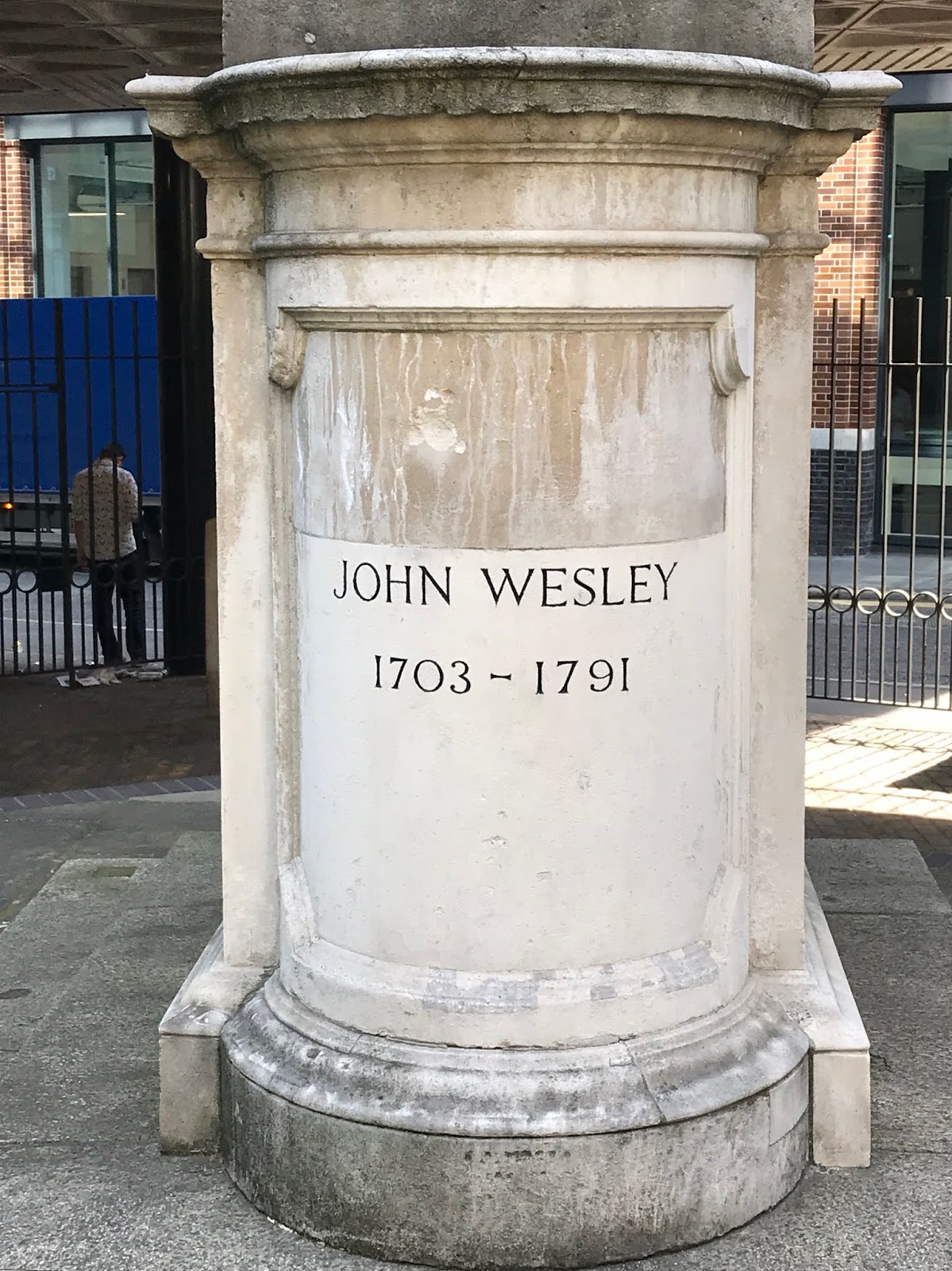
One afternoon, as I sat there basking in the sun and soaking up Wesley vibes, I read the epitaph carved into the side of the monument.  Composed by Adam Clarke, a giant in early Methodism, it waxes poetic about the impact John Wesley had on the Church and on the world.  At the bottom, it reads as you see in the picture. It describes him as a great light that arose to "revive, enforce, and defend the pure apostolical doctrines and practices of the primitive Church" and goes on to say that he lived to see "provision made by the singular grace of God for their continuance and establishment, to the joy of future generations."

That line "to the joy of future generations" resonated with me as I sat there and considered the strange and mysterious acts of God.  I meditated on the chain of events and the lives that have touched mine as part of a journey that led me to sit in that spot where I would reflect upon the life and ministry of John Wesley, who even in death continues to point towards Christ rather than towards himself.

Mr. Wesley clearly expected the Methodist movement to carry on after his death and made certain arrangements for that well before he died, but there is no way he could have envisioned the vast reach of his revival and the impact it continues to have on the lives of millions of people who are Christ-followers in the Wesleyan/Methodist tradition.  The rich diversity of ways that the joy of future generations is expressed would have astounded him!  During the 9 days of my London visit, I met children of Methodism from all across the globe, speaking many different languages, praising God in a variety of ways, and it was a rich and invigorating experience.  The Ghanaian Fellowship Choir led worship with praise that employed not just their voices but their whole bodies.  Without understanding a word they sang, I was nevertheless caught up in their joy in the Spirit.

After the service, it was a privilege to tour the Chapel and Wesley's House with a young man from South Korea and a family from Pakistan and see that we were all experiencing our time there in similar ways.  At one point, when our guide  (originally from Fiji) was talking about Wesley's opposition to slavery and his determination to press on despite opposition and threats, one of the members of the Pakistani family very quietly said, "Praise Jesus."  He then asked the guide to take a picture of our whole group as we stood in the shadow of the pulpit.  I wanted to give him my email address so he could send me a copy, but they left before I had the chance.  It truly was just a tiny foretaste of the life to come when we are all gathered together in Christ!

Mr. Wesley would have likely also been surprised at the existence of a female United Methodist elder from North Carolina, let alone the craziness of her coming all the way to the UK to seek a place of service within British Methodism.  Be that as it may, he certainly laid the ground work back in the day when women like Sarah Mallet, Mary Bosanquet, Sarah Crosby, and Sarah Ryan boldly stood to proclaim the gospel in front of crowds and congregations of both men and women.  And now that my interviewing process has been successfully completed, I await further word in the coming months about my future place of service as the stationing committee prayerfully discerns the needs of the churches and the gifts I bring.  May it be as God wills, and may we all, clergy and laity alike, be a Spirit-filled and Spirit-led part of the continuation of the Methodist revival, for the joy of those future generations who will follow us.


Tuesday, July 9, 2019

This is My Story, This is My Song

I arrived at Heathrow around 6:30 AM on Sunday and took the train to Paddington Station.  I had consulted the map of the Tube and knew which line I needed to take, but due to closures, I had to resort to plan B and C and then D, all while jet-lagged and hungry.  But I managed to figure things out  (not being too proud to ask for help is always a good thing!) and finally arrived at Wesley's Chapel around 9AM, chatted with my gracious hosts, took a shower, and stepped across the courtyard for worship.

It was a very full service, complete with confirmation and the sacrament of Holy Communion, and twice we sang bits of "Blessed Assurance," a much-beloved hymn written by Fanny Crosby, a Methodist laywoman who wrote thousands of hymns.  It was one of my mother's favorites, and I can almost hear her voice in my ear, particularly during the chorus.  "This is my story, this is my song. Praising my Savior all the day long ..."

Story. Song.  Both of those are integral to understanding this thing called Methodism.  Methodism is a movement born of a flaming desire to tell and to live out THE story, a movement nurtured in the communal singing of that story, a movement marked by honoring both heart and head in the striving for a life of holiness.   

My last sermon at First Presbyterian Church was rooted in the epistle lesson designated by the lectionary for June 23, Galatians 3: 23-29.  These verses are Paul's reminder that our most essential identity is our oneness in Christ and not our racial/ethnic or socio-economic status, nor our gender identity or political affiliation,which is not to say that those things don't matter.  However, for Christians, it is who we are in Christ, as individuals and as a community whose story-threads are woven together into God's story, that tells us who we are and what we are to be about.

I watched some of the proceedings of the Methodist Conference via live stream while I was still in North Carolina, and was delighted to hear that the theme taken by the new president, the Rev. Barbara Glasson  is "So What's the Story?"  In her address to Conference, she spoke of the necessity of hearing and honoring each other's stories and of our calling to keep telling "the old, old story of Jesus and his love" in new ways, giving a faithful account that points to the nourishing life that comes from following Jesus as we encounter others and listen to their stories.


The Holy Spirit is actively working in the world, within and through us, enabling us to remember that we have a story and a song to share with the world.  And so I close with that question that calls us to remember who we are and to whom we belong, a question that demands that we pay attention to our neighbors and the threads that bind us to them and us all to God. And I also close with the words of another Methodist woman and her poetry that proclaims that the good news of Love in Jesus Christ IS our story and our song, and so with our lives as well as our lips, we will praise him all the day long.

Blessed assurance, Jesus is mine!
O what a foretaste of glory divine!
Heir of salvation, purchase of God, 
Born of His Spirit, washed in His blood.

This is my story, this is my song, 
praising my Savior all the day long; 
this is my story, this is my song, 
praising my Savior all the day long. 


Wednesday, July 3, 2019

"Put Me To What Thou Wilt"


20 years ago, on June 13, 1999,  I became an elder in the North Carolina Conference of the United Methodist Church.  I had already been ordained in 1992 in a Southern Baptist church but for various reasons having to do with Wesleyan theology (head) and with a feeling of having come home in the UMC (heart), I began serving my first appointment at a two-point charge in 1996.  My orders were "recognized" as a deacon in 1997 and then after serving 2 more years and appearing before the Board of Ordained Ministry again, I was finally officially an elder (which is the same as a presbyter or a priest.) 

It has been an interesting journey. Very little about it has been predictable, and none of it has been boring.  I have had moments of searing grief and pain, hours of sheer delight and wonder, and times of confusion and indecision.  But at no point has my faith in Christ left me, nor has my conviction that my vocation is and always shall be as an ordained minister.

Over the past several months, after an extended period of discernment, it became apparent to me that I was being led towards a new chapter, something that is both radically different and reassuringly similar.  I began to explore the possibility of becoming "Recognised and Regarded" in the Methodist Church in Britain, a very long process that has involved the writing of papers on my part, submitting lengthy letters of reference by people who know me well, a Skype interview (and you haven't lived until you've been assessed face-to-face via the wonders of the internet!), a process that now necessitates my travel to London in just a few days for a psychological evaluation and a formal time of being interviewed. 

I have packed and re-packed several times, and I'm not quite sure why it's so much harder this time than it was for my sabbatical in 2017.  Maybe it's because of the anxiety that accompanies being scrutinized and examined.  Maybe it's because it involves change and meeting new challenges. Maybe it's because the outcome is quite honestly unknown.  There is, after all, no guarantee that I will "pass" or that a suitable station that matches my gifts with a circuit's needs will be available even if I do.  Following the interviews, the only employment of my time that is a given is the five weeks I will spend preaching in the Tiree Parish Church in the most westerly island of the Inner Hebrides -- and that has nothing whatsoever to do with Methodism since it is a Church of Scotland congregation!


Although he can come across as extremely directive (aka bossy) and sure of himself, John Wesley also had seasons of disappointment and uncertainty.  He seemed all set for an academic career at Lincoln College, Oxford but then veered off in another direction -- literally -- by heading to the colony of Georgia, of which he had high hopes.  Alas, much of his time there was anything but successful, although it is interesting that even at that early stage he showed respect for a woman's spiritual life even if it conflicted with her husband's wishes.  He was, after all, the son of  Susanna Annesley Wesley! 

However, his strict understanding and practice of the rites of the Church (immersion of infants and refusal to preside at the burial of a non-Anglican, for example) and of course, his disastrous love affair with Sophy Hopkey, sent him reeling back home to England, unsure of his ministry's direction and feeling personally dejected.  But look how God used him and all the varied experiences of his life, the joyful as well as the sorrowful, to fan the flames of a revival whose fire still burns today! 

Even in his most troubled hours, John Wesley sought the will of God, trusting that the Spirit was at work even if he couldn't presently see just how.  His appropriation of the Covenant Prayer sums up his life's deepest orientation well, and it is one that I pray every day of my life, seeking to place all that I have and all that I am in the hands of the good God who loves me so, even in this time of great upheaval and change in my life:

I am no longer my own, but thine.
Put me to what thou wilt, rank me with whom thou wilt.
Put me to doing, put me to suffering.
Let me be employed by thee or laid aside for thee,
exalted for thee or brought low for thee.
Let me be full, let me be empty.
Let me have all things, let me have nothing.
I freely and heartily yield all things
to thy pleasure and disposal.
And now, O glorious and blessed God,
Father, Son, and Holy Spirit,
thou art mine, and I am thine. So be it.
And the covenant which I have made on earth,
let it be ratified in heaven. Amen.

Saturday, June 29, 2019

"Blest be the dear uniting love"


Well, what a difference a week makes!  This time last week, Scott and I were exhausted from loading the last big pieces of furniture and boxes of "stuff" from my office at First Prez into our cars and depositing everything pretty much as you see it here, in the middle of the house.  I was sitting down to run through my sermon one more time, praying that I would be able to contain my tears until after the second worship service.  As Scott and I talked late into the evening, we laughed and cried as we remembered some of the tumultuous events of the last 8 years of ministry shared with the people there, especially as we remembered some of those saints of God whose hands I held as they lay close to death and whose funerals I preached.  

As Sunday rolled around, I was hopeful that I could remain tearless until at least 12:01pm, and actually, that was the case until about 12:07 or thereabouts, and I was able to say the things I felt the Spirit leading me to say to the congregation this one last time of standing before them in the pulpit.  Dr. Monica Sparzak had composed an arrangement of "O, For A Thousand Tongues to Sing" and "Lo, He Comes with Clouds Descending"  which she played as the prelude, so it was a very Methodist-infused service of worship, which surprised no one.  I told them they had learned more about Wesley than they could have ever expected or wanted! We sang "Ye Servants of God," I quoted from the United Methodist Book of Worship as well as the Presbyterian Book of Common Worship, and I read one of Charles Wesley's hymns as the closing blessing.  It was a time of giving thanks for the way our stories have intersected and a time to celebrate the ties that will continue to bind us no matter how many miles may lie between us.  As Galatians 3: 23-29 tells us, our essential identity is our unity in Christ, and that is stronger than even the parts of ourselves that we oft-times think most important:  our racial/ethnic background, socio-economic status, or gender identity.   

As I write this, I am still in Fayetteville, but this time next week, I will be on an airplane high above the Atlantic, heading towards a new chapter, a new adventure, a new path forward in ministry. It is impossible to say how things will unfold and what the future holds, but I hold fast to the words I shared with them from the pen of Charles Wesley  as words of promise, hope, and trust --

Blest be the dear uniting love
that will not let us part;
our bodies may far off remove,
we still are one in heart. 

Joined in one spirit to our Head,
where he appoints we go,
and still in Jesus' footsteps tread,
and do his work below. 

O may we ever walk in him,
and nothing know beside,
nothing desire, nothing esteem,
but Jesus crucified! 

We all are one who him receive,
and each with each agree,
in him the One, the Truth, we live;
blest point of unity! 

Partakers of the Savior's grace,
the same in mind and heart,
nor joy, nor grief, nor time, 
nor place, nor life, nor death can part.


Wednesday, June 19, 2019

Parting is Such Sweet Sorrow


It would be hard to top Shakespeare if you're looking for a word or phrase to describe a human emotion, and in Juliet's good night speech to Romeo he really nailed the bittersweet nature of goodbye.  That is much of what I am experiencing this week, my last week as one of the pastors of First Presbyterian Church.  For nearly 8 years, this United Methodist minister has been the primary pastoral care point of contact at a PCUSA church which has warmly received my ministry, and we have been through much gladness and sorrow together.  Along the way, we have become interwoven into each other's stories, and that makes the parting sweet sorrow indeed.  As I leave them to pursue possible ministry opportunities with the Methodist Church in Britain, my heart is full of memories and with grief, even as it is filled with joyful anticipation for what lies ahead. 

As people in the South typically do, we express a lot of emotion with food, and I have eaten with more members of the church in the past week than I could have ever imagined.  They must think I'll starve!  Just yesterday, the Stephen Ministers and I shared a luncheon that was soaked in laughter and more food than we could easily eat.  The lovely flower in this picture was given to me by one of the Stephen Ministers who has a rare and true gift for creating beautiful floral arrangements that convey the holiness of God in every bloom.  I call this her Pentecost flower, and you can certainly see why!  As I drove away from our meal, I was overcome with gratitude for their commitment to caring for others, for their unflagging support and encouragement, for their shared companionship during my ministry here, and for God's good blessings in bringing us together.

It was much the same feeling I had at my college reunion in May and at Annual Conference just last week, the same feeling I experience each Wednesday at the Episcopal church at eucharist.  A deep and abiding sense of the movement of the Spirit weaving complicated threads together to create a radiant tapestry of connectedness.  A confidence in the ongoing presence of Christ who calls us to become his Body on earth and promises to never leave us to go it alone.  A trust in the blessedness of the bonds of Love that bind us to God and to one another, ties that keep us from falling off the edge.

The Methodist revival at its best was and is all about connection even where there are differences of opinion and in "A Catholic Spirit" John Wesley asks the reader if her/his heart is right with God and her/his faith filled with the energy of love.  He presses the point by emphasizing service, joyful reverence, and love expressed by good works to one's neighbor. He pleads for a bond forged in love, as he seeks to be loved "with love that is long-suffering and kind."  These are central Christian characteristics, whether one is a child of Wesley or not, and glimpses of that love have been frequent in this gathering of Presbyterians; their heart is as my heart, which yearns to have Christ enthroned there. So, yes, parting is indeed sweet sorrow, even as we recognize and celebrate the ties of faith and love that cannot be broken, no matter the distance.

In the sixth century, Dorotheus of Gaza wrote of this connection, symbolizing it with the shape of a circle --

Imagine that the world is a circle, that God is the center, and that the radii are the different ways human beings live. When those who wish to come closer to God walk towards the center of the circle, they come closer to one another at the same time as they come closer to God. The closer they come to God, the closer they come to one another. And the closer they come to one another, the closer they come to God.

Just so, we will always be together, drawn ever closer to the heart of God. Thanks be to God! Amen.


Monday, June 17, 2019

Holy Conferencing and Division


The people of the North Carolina Annual Conference of the UMC met in Greenville last week for our yearly (that's why it's the Annual Conference) time of gathering for what John Wesley called "holy conferencing" or "holy conversation."  It's been a rough couple of years in NC, symbolized in part by the cross in the picture on the left. It was created from bits and pieces of "stuff" that was found all over the eastern part of our state in the aftermath of Hurricane Florence, hence the ominous-looking swirl of material that dominates it.  Consecrated as a reminder of the resurrection power of God who can take the worst of circumstances and yet work through fallible, frail human beings like you and me in order to bring new life out of the chaos, it was a powerful symbol of not only the violent natural storms that batter our state but also the destructive forces ripping our Connection as United Methodists apart.

Coming just a few months after the bloodbath that was the special called General Conference, there was more than a little apprehension on the part of many, including myself.  What would happen when the voting for delegates to General and Jurisdictional Conference began?  What would we say to each other when/if tensions flared?  Could we calmly and respectfully discuss the resolutions?  And most importantly, could we celebrate the wonderful mission and ministry that we are able to do together in Jesus' name, in North Carolina and into all the world?

As it turned out, there was a Spirit of joy among many of us and a Spirit of thanksgiving for the ways we care for hurricane victims (thousands of whom are right here in our Conference) together, the ways we minister alongside women in Sierra Leone as they create beautiful textiles to support their families, the ways we literally and figuratively encourage the rebuilding of lives and homes and futures, all as part of our mission of making disciples for Jesus Christ for the transformation of the world.

We heard sermons about the generous God who calls us to be equally generous as we participate in the UMC's ministries through our prayers, presence, gifts, service, and witness.  We rejoiced to celebrate 150 years of UMW servant ministry and to engage with the exuberance of our youth who confidently presented several resolutions -- all of which passed.  We sang "And Are We Yet Alive," and "O, For A Thousand Tongues to Sing," and "Love Divine, All Loves Excelling," we feasted on the bread and cup of holy communion, remembered our newly deceased pastors and their spouses in a beautiful memorial service, and as we commissioned and ordained sisters and brothers to the orders of deacon and elder.  The Spirit was there in our midst, and we were caught up in the Pentecost wind and flame.

And yet.  The shadow of General Conference and the past decades of turmoil hung over us.  There were feelings of hurt, of grief, of anger, of resignation to the impending break-up of the United Methodist Church.  The results of the elections of our Conference delegates were lauded by many even as they filled others with despair.  We are a divided Conference.  We are a divided Church.  It is heartbreaking for many of us, and it would certainly have grieved the heart of our father John Wesley who defined schism as "evil in itself."   In his sermon "On Schism," he writes in words that achingly and accurately describe our modern predicament:

And as such a separation is evil in itself, being a breach of brotherly love, so it brings forth evil fruit; it is naturally productive of the most mischievous consequences. It opens a door to all unkind tempers, both in ourselves and others. It leads directly to a whole train of evil surmising, to severe and uncharitable judging of each other. It gives occasion to offense, to anger and resentment, perhaps in ourselves as well as in our brethren; which, if not presently stopped, may issue in bitterness, malice, and settled hatred; creating a present hell wherever they are found, as a prelude to hell eternal.


Alarmingly, he goes on to state:

But the ill consequences of even this species of schism do not terminate in the heart. Evil tempers cannot long remain within, before they are productive of outward fruit. Out of the abundance of the heart the mouth speaketh. As he whose heart is full of love openeth his mouth with wisdom, and in his lips there is the law of kindness; so he whose heart is full of prejudice, anger, suspicion, or any unkind temper, will surely open his mouth in a manner corresponding with the disposition of his mind. And hence will arise, if not lying and slandering, (which yet will hardly be avoided,) bitter words, tale-bearing, backbiting, and evil-speaking of every kind.

The more things change, the more they stay the same.  Just as in Wesley's day, whenever suspicion and distrust are found, gossip and ugly words and bitterness are never far behind, which is abundantly attested to by even a brief perusal of Facebook posts.  So I don't naively assume that just because we were able to stand shoulder to shoulder during worship and exult in the ways in which we are doing good to as many people as we can, our differences have somehow vanished or will soon disappear. I do, however, believe that the God whose Spirit brooded over the waters of chaos and engaged in the creation of an orderly and beautiful world filled with wondrous creatures and populated by women and men created in God's very own image can and will be present even in the division and conflict. I believe that God in the person of Jesus Christ has promised to always be with us, even to the end, prompting John Wesley to whisper from his deathbed that the very best thing of all is that God is with us.  And so, trusting that our God is indeed making all things new; how can I refrain from hoping?  How can I keep from singing? Alleluia, Amen!


Saturday, June 1, 2019

"Lord, Let Me Not Live to be Useless!"

If you google "John Wesley," you will find a host of different results.  There are articles, pictures, blogs (like this one), and more.  Some of them are scholarly, some are reflective, some are appreciative, and some are snarky, if not downright hateful.  (There is one website that calls him "Satanic," which really took me aback!)

One of the most popular type of Wesley sites is of the "favorite quotes" variety.  Everything from a top 100 list to a no-he-didn't-say-that list can be found online.  You'll find the usual suspects about strangely warmed hearts, about the world being his parish, and the good news that the best thing is that God is with us.  And you will almost always find some version of the one that I took the title of this post from -- "Lord, let me not live to be useless!"  It has been immortalized in stone in the churchyard of Wroot where he served as his father's curate 1727-1729, which is where this picture was taken.

Being a Wesley nerd and having studied under people like Richard Heitzenrater and Gayle Felton, I know the importance of context, so I will happily spend hours trying to trace a supposed Wesley saying back to its source.  While I am by no means an expert, and my search was anything but exhaustive given the extent of Wesley's writings, I have found two places where this quote is to be found.

Both are in his journal.  He had been preaching in Colchester and on December 22, 1763, he writes:

I spent a little time in a visit to Mr. M --, twenty years ago a zealous and useful magistrate, now a picture of human nature in disgrace -- feeble in body and mind, slow of speech and of understanding.  Lord, let me not live to be useless!

On December 8, 1764, almost exactly a year later, while in London he writes:

I saw one who many years ago was a "minister of God to us for good" in repressing the madness of the people, Sir John Ganson, who was near fifty years a magistrate and has lived more than ninety.  He is majestic in decay, having few wrinkles and not stooping at all, though just dropping into the grave, having no strength and little memory or understanding.  Well might that good man Bishop Stratford pray, "Lord, let me not live to be useless!"  And he had his desire:  he was struck with a palsy in the evening, praised God all night, and died in the morning.

My UK geography is a little shaky, but London and Colchester are approximately 68 miles apart, which is quite a distance if one is dependent on horses for transportation, and Mr. M -- is not the same name as Sir John Ganson, but I am struck by the similarities.  Both are described as long-serving magistrates who had been helpful to the Methodists and as elderly men whose old age is marked by physical and mental decline, a condition Wesley himself greatly wishes to escape.  In the first journal entry, he is himself exclaiming a fervent prayer to be spared this fate, while in the later entry, he is appreciatively quoting Bishop Stratford (about whom I know nothing) as exhorting the Almighty to grant him a quick death rather than a slow wasting away.

Harsh though his words may sound to us, it is important to understand that for the energetic John Wesley who was brought up with a Puritan expectation of redeeming every idle moment and spending every hour of every day in worship of God and in the furtherance of the gospel, the thought of not being mentally or physically capable of doing so was horrible. Life was short, and one needed to make the best use of it before it was over. This attitude was instilled in him from an early age, probably from both parents, as was the notion of having to give God in the life to come an account of how one had used the time given.  In her private journal, Susanna Wesley writes:

'Tis perhaps one of the most difficult things in the world to preserve a devout and serious temper of mind in the midst of much worldly business ...; we must work so much harder, we must be careful to redeem time from sleep, eating, dressing, unnecessary visits, and trifling conversation, that we be not forced to contract our private devotions into such a little space as may deprive us of the benefit and comforts of them.

It was a lesson learned well by both John and Charles Wesley.  Surely the urgency of being about the business of ministry lay behind this hymn -- 

A charge to keep I have,
A God to glorify,
A never-dying soul to save,
And fit it for the sky.

To serve the present age,
My calling to fulfill:
Oh, may it all my pow’rs engage
To do my Master’s will!

Arm me with jealous care,
As in Thy sight to live;
And O Thy servant, Lord, prepare
A strict account to give!

Help me to watch and pray,
And on Thyself rely,
Assured, if I my trust betray,
I shall forever die.

So then, for the Wesleys, and hopefully for us, being "useless" is different from spending quiet time with God, renewing and re-creating;  it is careless disposal of the moments that make up our lives without noticing that we are even doing so. In that sense, I must honestly confess that I am sometimes quite useless, that I am often what Wesley disparagingly called a "trifler."  I often fritter and waste time on Facebook or watching TV; I spend time gossiping, complaining, planning what I will eat or wear, letting minutes and even hours slip through my fingers that would be better spent in prayer and reflection, in reading scripture and applying it to daily life.  

Perhaps you are guilty of the same.  What would it take for me, for you, to re-center ourselves on Christ?  How long would it take for us to develop habits of holiness that do indeed "redeem" our time?  And are we earnestly striving after it?

Lord, let ME not live to be useless!

New Site for Blog

 To continue receiving my blog posts in your email, go to revdlf.wixsite.com/travelswithwesley and sign up to subscribe.  My latest post, ju...